Theories of Technology and Society
COM 539, Prof. Adrienne Russell, Spring 2020 – See Syllabus
This course focused on the social, cultural, and political implications of new communication and information technology. It looked to provide a foundation for social science and humanities approaches to technology, by introducing students to key theories and ideas. It exposed me to concepts such as technology, users, protocol, networks, power, identity, agency, and materiality, and to some of the theories that have been developed around them.
This course was a game-changer for me. It helped me identify key literatures, topics, and debates in the area of technology & society from a broad multidisciplinary perspective. Among other theories and debates, this course introduced me for the first time to the Technological Determinism v. Social Constructivism debate (including the Social Construction of Technology (SCOT) approach proposed by Trevor J. Pinch and Wiebe E. Bijker), Langdon Winner’s ideas about the politics of technologies, Bruno Latour’s Actor-Network theory (ANT), and Tarleton Gillespie’s perspective on algorithms and their relationship to power. It provided me with a toolkit of theoretical frameworks that have tremendously enriched my research. After almost three years, I keep going back to my notes from this course for references and context.
Final Product
As a culminating activity, I had to present a 15–20-page paper on a topic of my choice related to theories of tech & society. Taking into account my own research interests, my legal background, and Gillespie’s illuminating approach to algorithms, I used this essay to review the critical perspectives that had been developed up to 2020 around algorithms in the legal literature, the social sciences, and in the STS domain, and identify trends and gaps across the reviewed scholarship. As a result, I classified the different approaches into the following categories and sub-categories:
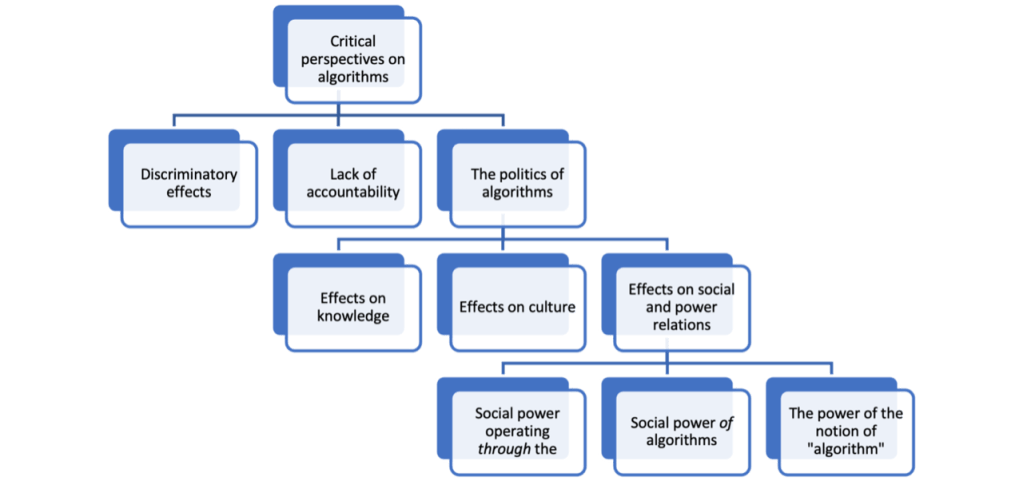
Across these approaches, I identified two particular trends or patterns that I considered worth mentioning. In light of the ultimate relevance of the first trend for the development of my own dissertation, I have copied its description here:
“First, it seems evident that there exists a relative correspondence between the disciplinary background of the scholars and the topics and corresponding methodologies that they tend to address and apply. In that sense, it is manifest that while legal scholars and computer scientists tend to focus on the lack of accountability of algorithms, social scientists are more inclined to highlight their discriminatory effects, and researchers that fit either under Arts or under the Science, Technology, and Social Studies (STS) domain are more propense to talk about the politics of algorithms. As an exception, it is important to highlight the work of Katherine O’Neill (2017), who despite coming from the domain of math, masterly addresses both the lack of accountability and the discriminatory risks of algorithms. Likewise, Kate Crawford’s work Can an Algorithm be Agonistic? Ten Scenes from Life in Calculated Publics (2016) is a worth mimicking example of how a law scholar can apply an STS approach.
However, except for those exceptions, there is an evident lack of interdisciplinary work, that needs to be solved. In particular, there is a need for scholars to begin borrowing from and sharing both topics and methodologies with other disciplines. For example, it would be interesting to see scholars from the STSS domain talking about algorithmic accountability, or to have legal scholars adopting a Social Construction of Technology (SCOT) or an Actor–Network Theory (ANT) approach to address the discriminatory effects of algorithms.”
References
- Beer, D. (2017). The social power of algorithms. Information, Communication & Society, 20(1), 1-13.
- Berry, D.M. (2019). Against Infrasomatization. Towards a critical theory of algorithms. In D. Bigo, E. Isin, and E. Ruppert (Eds.), Data Politics. Worlds, Subjects, Rights. London: Routledge.
- Bijker, W.E. (2010). How is Technology Made?–That is the Question. Cambridge Journal of Economics, 34(1), 63-76.
- Bucher, T. (2018). If…Then: Algorithmic Power and Politics. New York: Oxford University Press.
- Crawford, K. (2016). Can an Algorithm be Agonistic? Ten Scenes from Life in Calculated Publics. Science, Technology & Human Values, 41(1), 77-92.
- Just, N. & Latzer, M. (2017). Governance by algorithms: reality construction by algorithmic selection on the Internet. Media, Culture & Society, 39(2), 238–258.
- Lange, A., Lenglet, M., & Seyfert, R. (2019). On studying algorithms ethnographically: Making sense of objects of ignorance. Organization, 26(4), 598–617.
- Lievrouw, L. A. (2014). Materiality and media in communication and technology studies: An unfinished project. In Gillespie, Boczkowski, & Foot (eds.), Media Technologies. Cambridge: MIT Press.
- O’Neill, C. (2017). Weapons of Math Destruction. New York: Broadway Books.
- Pacey, A. (1983). The Culture of Technology. Cambridge: MIT Press.
- Snake-Beings, E. (2013). From Ideology to Algorithm: the Opaque Politics of the Internet. Transformations Journal of Media & Culture, 23, 1-9.
- Winner, L. (1980). Do artifacts have Politics? Daedalus, 109, 121- 36.
- Ziewitz, M. (2016). Special Issue Introduction: Governing Algorithms: Myth, Mess, and Methods. Science, Technology, & Human Values, 41(1), 3-16.
Selected Readings
- Pacey, A. (1983). The Culture of Technology. Cambridge: MIT Press.
- Bijker, W.E. (2010). How is Technology Made?–That is the Question. Cambridge Journal of Economics, 34(1), 63-76.
- Winner, L. (1980). Do artifacts have Politics? Daedalus, 109, 121- 36.
- Latour, B. (2007). Reassembling the Social: An Introduction to Actor-Network Theory. Oxford University Press.
- Gillespie, T. (2014). The relevance of algorithms. In Gillespie, Boczkowski, & Foot (eds.), Media Technologies. Cambridge: MIT Press.
 MARÍA P. ÁNGEL